
Clark County Criminal Court Records
A criminal court record is the court case file opened after the State of Indiana files a criminal matter in Clark County. It is not just a charge list and it is not the jail roster. The case record can include the charging instrument, probable-cause material if public, appearances, bond, summons or warrant history, motions, hearing entries, plea entries, trial settings, disposition, sentencing orders, fines, costs, probation terms, and final judgment.
Clark County's criminal case assignments are local and specific. Circuit Court No. 1 handles murder and higher felony cases filed in even-numbered months, plus certain other matters. Circuit Court No. 4 handles comparable serious felonies filed in odd-numbered months and juvenile-defendant allegations. Circuit Court No. 2 handles higher felony controlled-substance and legend-drug cases. Circuit Court No. 3 handles Level 6 felony matters and OWI or motor-vehicle criminal cases. Superior Court No. 5 handles misdemeanor offenses other than OWI.
The prosecutor page assigned to this record group comes from the Clark County Prosecuting Attorney's Office.
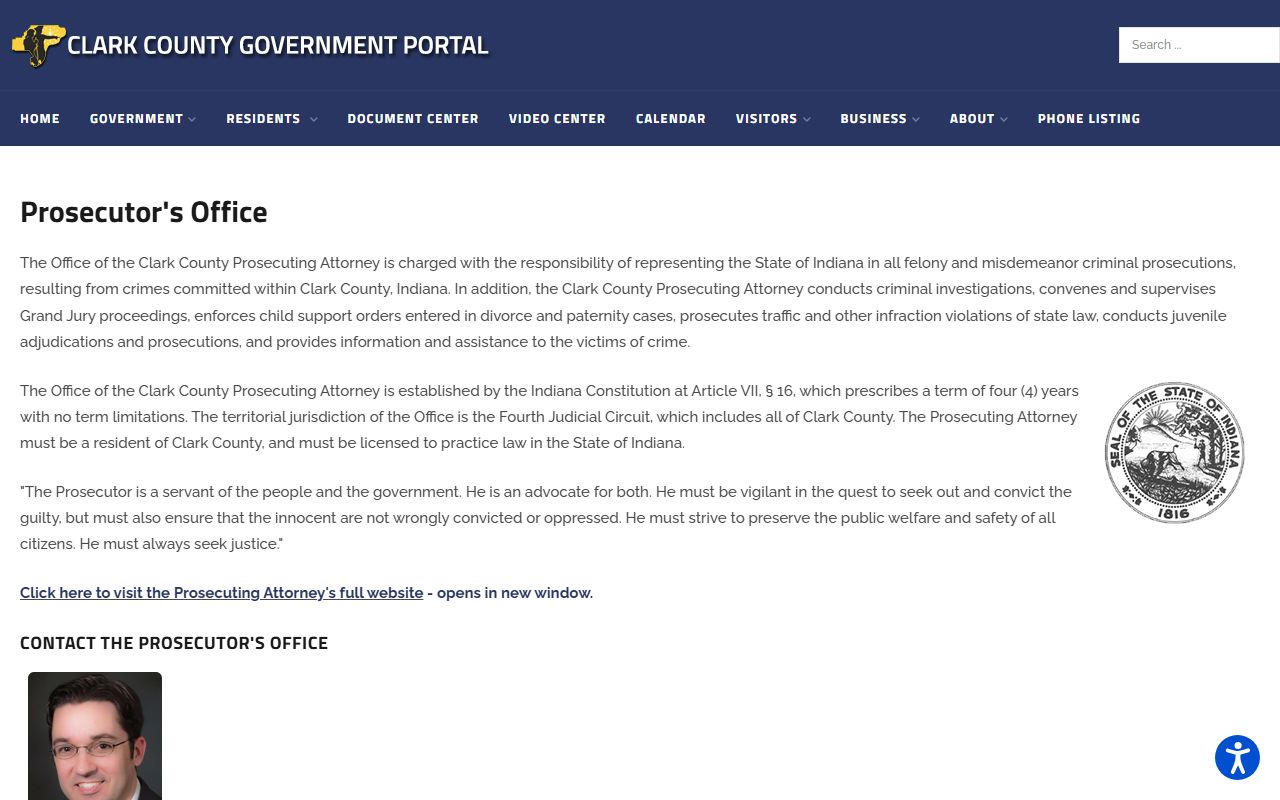
The Prosecutor is relevant because felony and misdemeanor prosecutions in Clark County are brought in the name of the State of Indiana.
Search Clark County Criminal Cases
Indiana MyCase is the main online search point for Clark County criminal court records. Search by defendant name, cause number, attorney, or other available criteria, then filter to Clark County when possible. Criminal case types commonly include felony and misdemeanor codes, and the docket may show charges, hearings, plea events, sentencing entries, and financial balances.
- Open Indiana MyCase and use the party, case number, or attorney search.
- Filter to Clark County or confirm the court shown in the result.
- Open the criminal case and review the case type, filed date, status, court, and judicial officer.
- Read the chronological case summary for charges filed, hearings, motions, pleas, disposition, and sentencing.
- Check document links for public final orders or judgments, when available.
- Contact the Clark County Clerk of the Courts for certified copies, older files, or public documents not linked online.
Statewide jail or custody tools do not replace the criminal case file. INjail, VINE, SAVIN, and IDOC tools can help check custody status, booking information, notifications, or prison assignment, but a court case result and a custody result answer different questions. The court record controls the case status, plea, disposition, and sentence.
Clark County Criminal Case Flow
Criminal court records build over time. A case may start with an arrest, summons, or filing decision, but the court file becomes most useful once the formal charge is filed and docket activity begins. Each stage can leave an entry in the Clark County criminal court record.
Case flow: Charges Filed › Arraignment › Pretrial / Motions › Plea or Trial › Disposition › Sentencing
| Stage | What Happens |
|---|---|
| Charges filed | The Prosecutor files the formal accusation, often by information, complaint, or indictment. |
| Arraignment | The defendant is advised of the charge and enters an initial plea or receives future settings. |
| Pretrial / motions | The docket may show discovery, continuances, bond issues, suppression motions, or other requests. |
| Plea or trial | The case resolves by plea, bench trial, jury trial, dismissal, or another court ruling. |
| Disposition | The record shows the result of each charge, such as guilty, dismissed, acquitted, or amended. |
| Sentencing | The record may show jail, prison, probation, fines, costs, restitution, or other terms. |
What Clark County Criminal Records Show
A Clark County criminal court record should be read charge by charge. One case can have several counts, and each count can have a different status. A case may also include bond entries, warrant or summons history, appearances, attorney notices, trial settings, plea deadlines, sentence modification requests, probation entries, and payment events.
| Field | What It Shows |
|---|---|
| Cause number | The unique Indiana case identifier for the criminal court file. |
| Court | The assigned Clark Circuit or Superior Court handling the case. |
| Defendant | The person charged, with public identifiers limited by access rules. |
| Charges | The offense wording, statute reference, level or class, and count status when visible. |
| Bond | Bond type or amount, cash-only status, or release-related docket entries. |
| Plea | The defendant's formal response, such as not guilty or guilty. |
| Motions and orders | Requests to the court and the judge's rulings. |
| Hearings | Dates, times, hearing types, judge or magistrate, and courtroom when posted. |
| Disposition | The result of each charge, including dismissal, guilty finding, acquittal, or amendment. |
| Sentence | Jail, prison, probation, fines, costs, restitution, and other terms if imposed. |
For a narrower view of the charges filed after an arrest, use Clark County arrest records and court charges. That record path focuses on the arrest-to-charge stage rather than the full criminal case file.
Charges vs Convictions
A charge is an accusation filed in court. A conviction is a result that follows a guilty plea, guilty verdict, or other qualifying finding. Clark County criminal court records may show charges that were dismissed, amended, reduced, merged, or resolved without a conviction. Do not read a filed charge as proof of guilt.
| Question | Charge | Conviction |
|---|---|---|
| Case stage | Begins or frames the prosecution. | Appears after plea, verdict, or qualifying finding. |
| Proof level | Based on charging standards and probable cause. | Requires proof beyond a reasonable doubt or an admitted plea. |
| Record meaning | Shows what the State alleged. | Shows the legal outcome of a charge. |
| Possible status | Pending, amended, dismissed, dropped, or merged. | Final unless later modified, appealed, sealed, or expunged. |
Public Clark County Criminal Records
Criminal court records in Clark County are generally public unless a court rule, statute, sealing order, or confidentiality law restricts access. Indiana Code 5-14-3 is the state Access to Public Records Act. The Indiana Rules on Access to Court Records govern court-record access and confidential filing requirements. Public MyCase documents may include some criminal final orders and judgments, but not every public criminal document is online.
The Indiana expungement image assigned to this page comes from Indiana Code 35-38-9.
That statute matters because many criminal record limits in Indiana depend on whether a case qualifies for sealing, restriction, or expungement treatment.
Key access rule: Public access starts with MyCase, but the Clerk remains the source for certified copies and public documents not linked online.
Sealed vs Expunged Records
Indiana expungement is not always deletion. Research from the Indiana Judicial Branch notes that some eligible arrest and conviction records are sealed from public access, some agencies are restricted from releasing them, and some convictions remain visible but marked expunged. Once an expungement petition is granted, the expungement case itself becomes confidential.
| Question | Sealed | Expunged |
|---|---|---|
| Public visibility | Removed from normal public access. | May be sealed, restricted, or marked expunged, depending on category. |
| Record existence | The record still exists, but access is limited. | The record is not always destroyed under Indiana law. |
| Case examples | Juvenile, protected, confidential, or court-sealed matters. | Eligible arrests, misdemeanors, Level 6/Class D felonies, or other eligible convictions. |
| Venue | Handled by the court that controls the record. | Petitions are filed in a circuit or superior court in the county of conviction. |
Clark County Prosecutor Role
The Indiana Prosecuting Attorneys Council profile identifies Jeremy T. Mull as the Clark County Prosecuting Attorney. The official county page says the Prosecutor represents the State of Indiana in felony and misdemeanor prosecutions resulting from crimes committed in Clark County. Duties also include criminal investigations, grand jury proceedings, juvenile adjudications, traffic and infraction prosecutions, child support enforcement, and victim assistance.
The IPAC image assigned to this page comes from the state prosecutor profile for Clark County.
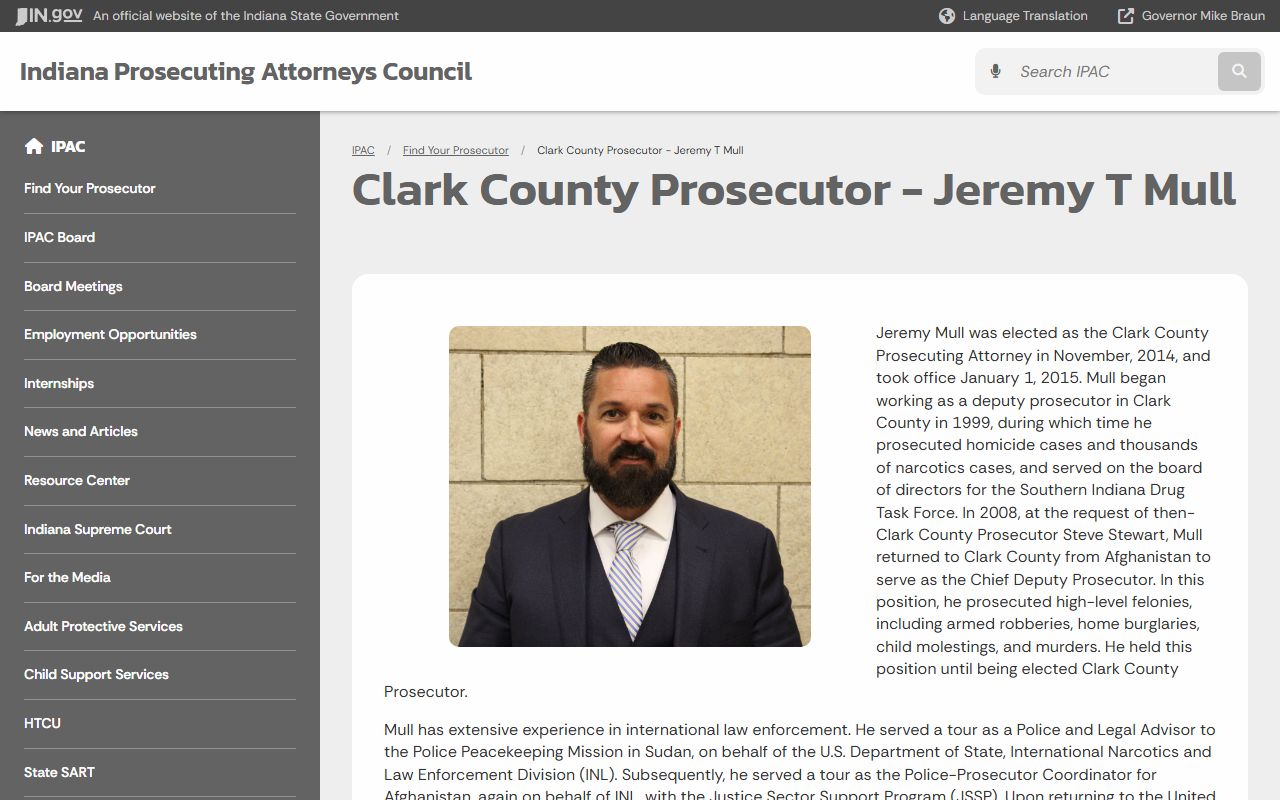
The prosecutor profile helps explain why criminal court records show the State of Indiana as the prosecuting party rather than a private complainant.
Clark County Prosecuting Attorney
Clark County Judicial Center, Room 215
501 E. Court Avenue
Jeffersonville, IN 47130
Criminal Division: 812-285-6264
Monday-Friday, 8:30 a.m.-12:00 p.m. and 1:00 p.m.-4:30 p.m.
Restricted Clark County Criminal Records
Criminal-related access limits are strongest for juvenile records, sealed records, expunged records, protected-person information, and filings with personal identifiers. Juvenile court records under Indiana Code 31-39 are generally confidential, and Clark Circuit Court No. 4 handles many juvenile matters. Access to adoption records is also restricted, though adoption is not a standard criminal case type.
Bond and custody data should also be read with care. The Sheriff's bond page says cash or surety and court cash bonds are collected 24 hours a day, but cash-only bonds must be paid directly to the Clerk of Courts. Bond information in a criminal case is part of the court record, while custody status can change through jail systems before the court docket updates.
Important: A criminal charge, jail booking, or warrant entry is not the same as a final conviction.